 中文版
中文版 English
Application
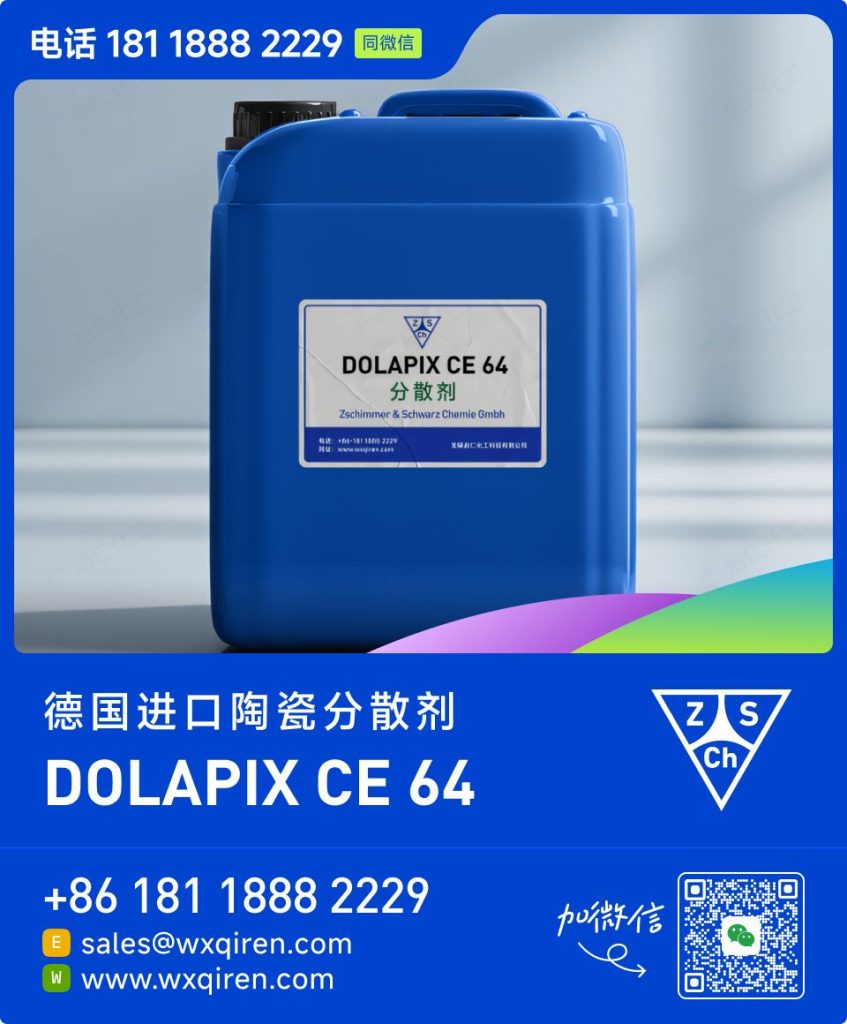
DOLAPIX CE 64 is an organic deflocculating agent, that is free from alkali. It does not foam.
DOLAPIX CE 64 makes it possible to produce slips with a high solids content and is, therefore, particularly suitable for deflocculation before spray drying.
Since the product is liquid and is thus completely dissociated, the deflocculation effect commences immediately after addition to the slip. Hence, it is possible at any time to adjust the viscosity of the slip by rapid, homogeneous incorporation into the slip.
DOLAPIX CE 64 can be employed in combination with the conventional temporary binders, such as polyvinyl alcohols, polymer dispersions, polysaccharides, cellulose derivatives and others (OPTAPIX types).
The deflocculation effect of DOLAPIX CE 64 is a result of interaction between the bivalent functional groups of the additive and the surface charge of the ceramic particles. The absorption onto the particles that is associated with this effects a decrease in the slip’s viscosity.
The amount that must be added ranges between 0.1 an 0.5 % of the solids content of the slip.
Shelf-life / Packaging
12 months under proper conditions
drums of 30 and 150 kg, containers of 1100 kg
Note
A yellow to brown coloration can be produced under the effect of light. This does not affect the activity of the deflocculant adversely.
Ceramic Dispersant: In‑Depth Application Case Analysis
As an alkali‑free organic dispersant, this product is primarily designed for high‑solids ceramic slurries, with wide applications in the preparation of zirconia, alumina, and other ceramic materials. It has been validated in both laboratory research and industrial production scenarios, as detailed below:
Yttria‑Stabilized Tetragonal Zirconia (YTZP/YSZ) Slurry and Particle Preparation
This dispersant is widely recognized as highly effective in aqueous zirconia slurries. In studies on yttria‑stabilized zirconia (YSZ) particle preparation, it is often used as a low‑molecular‑weight dispersant in combination with polyvinyl alcohol (PVA) binders. Researchers specifically investigate its synergistic effect with suspension pH on key YSZ particle properties such as tap density, Hausner ratio, and angle of repose, in order to optimize the overall preparation process.
However, it exhibits limitations in the gel‑casting of aqueous yttria‑stabilized tetragonal zirconia (YTZP) slurries. Its functional groups readily react with the monomer ethylene glycol diglycidyl ether (EGDE), which shortens the gel‑holding time and causes a rapid increase in slurry viscosity, potentially leading to gel‑casting failure.
2. Stabilization of Alumina–Zirconia–Silicon Carbide (AZS) Composite Suspensions
It is one of the few high‑performance dispersants that works effectively in both alumina and silicon carbide systems, making it suitable for stabilizing alumina–zirconia–silicon carbide (AZS) composite suspensions. Its molecules strongly adsorb onto the surface of alumina and other particles, and through interactions between divalent functional groups and surface charges, it effectively prevents particle agglomeration and ensures long‑term dispersion stability. This provides a solid foundation for the subsequent production of high‑performance AZS composite ceramics, particularly in specialty ceramic applications requiring exceptional material stability.
3. Barium Calcium Zirconate Titanate (BCZT) Ceramic–Polymer Composite Preparation
In experiments involving the preparation of composites based on barium calcium zirconate titanate (BCZT) ceramics and polyetherimide (PEI), this product was used as the dispersant for the ceramic suspension. At a ceramic solids loading of 30 vol%, it enabled the formation of a well‑defined 2D layered ceramic framework, with vertically aligned, nearly parallel structures in the freezing direction and a grain‑layer thickness of approximately (5.5 ± 1.4) μm.
At higher loadings of 40 vol% and 50 vol%, the structures transitioned to multi‑grain porous architectures and isotropically distributed ceramic structures, respectively. However, the study also indicated that compared with Tris–HCl dispersants, its dispersion effectiveness was slightly weaker, resulting in narrower gaps between ceramic grain layers, which can impede the infiltration of high‑viscosity polymer fillers into the pores.
Industrial Deagglomeration of Ceramic Slurries Prior to Spray Drying
This is a very typical and important industrial application. In production lines for daily‑use ceramics and specialty ceramics that employ spray drying, high‑solids slurries often suffer from agglomeration and uneven viscosity before drying. The addition of this dispersant enables rapid and complete dispersion, with immediate deagglomeration effects.
Operators can also adjust slurry viscosity in real time through stirring to meet the flowability and uniformity requirements of the spray‑drying process. Its foam‑free characteristic prevents foam‑related defects in the particle size and forming quality of the dried ceramic powder. Moreover, it is compatible with commonly used temporary binders such as PVA, allowing integration into existing formulations without major adjustments.
Dispersion of Alumina, Titania, and Other Ceramic Slurries
In laboratory and small‑scale production settings, it is commonly used for deagglomeration and dispersion in single‑component ceramic systems such as alumina and titania. For example, in the production of alumina ceramic green bodies or titania‑based functional ceramics, adding 0.1%–0.5% of this dispersant (relative to slurry solids) can effectively reduce viscosity and ensure uniform flow during shaping. This contributes to higher density and improved microstructural homogeneity in the final ceramic products.